
2013Starting point
Original plan: replace the entire roof
160 000 €budgeted for a full roof replacement
Bitumen roofs on three apartment blocks, 21 years old in 2013.
Regular inspections turn roof repairs from surprise costs into a planned part of the building's lifecycle. A toolkit for property managers and housing companies that makes it easy to plan the roof's lifecycle safely and cost-effectively.
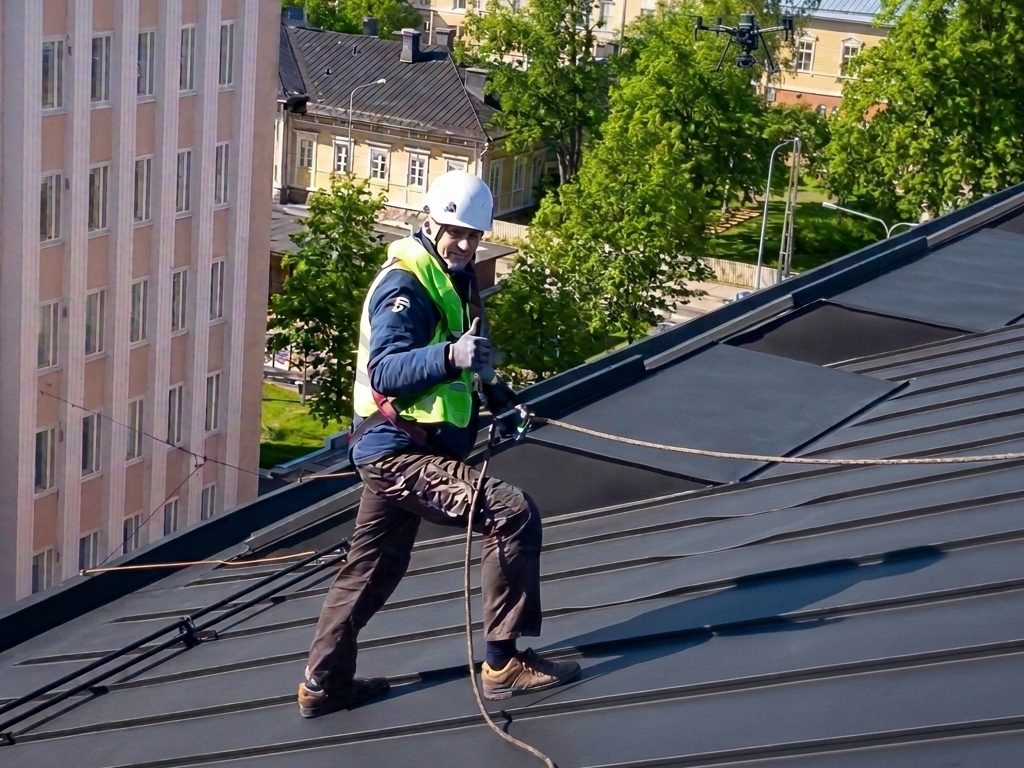
Prevention is cheaper than fixing problems after they happen.
In 2013, the housing company was advised to replace its roof for 160 000 €. They chose differently, and we started providing lifecycle services together.
A real property, not a hypothetical example. Figures up to 2026 are actual. The years 2028 and 2037–2038 are estimates.
The illustration could not be loaded in this browser.
Bitumen roofs on three apartment blocks, 21 years old in 2013.
We were invited to assess the roofs and introduced lifecycle thinking: annual maintenance and inspections for the roof surfaces, with measures planned ten years ahead. The housing company has followed the model ever since.
The most urgent spots were treated with long-life sealing (6 000 €). At the same time, the flashings on access hatches and lift motor room upstands were renewed. The saving already stood at 151 000 €, even though no one could yet prove the approach would pay off.
The roof surfaces are inspected twice a year, and minor defects are fixed straight away, before they can turn into leaks. Every visit is reported to the housing company.
The bitumen roof was given a treatment to restore its elasticity. By then the membrane was 28 years old.
The roof is covered with smooth-surfaced Derbigum. The Belgian manufacturer promises a 45-year service life, and when an extra layer is added within the first ten years, the lifecycle extends to as much as 90 years. Water runs off and dries quickly on the smooth surface, the membrane is thick, and there are no loose granules to block the roof drains.
The additional sealing cost 5 000 €, and minor repairs have been made over the years. Total costs since 2013 come to about 30 000 €.
A second elasticity-restoring treatment for the bitumen roof is expected in 2028. The membrane will then be 36 years old.
The manufacturer's calculated service life runs out in 2037. Had the roof been replaced in 2013 with granule-surfaced bitumen, which lasts about 25 years, it would be at the end of its life in 2038, with a second full replacement already looming. With the lifecycle model, the roofs are being replaced for the first time.
Calculation: recommended replacement 160 000 € minus lifecycle model costs of about 52 000 €. Costs include the annual lifecycle services (inspections and maintenance) and the estimated second elasticity treatment in 2028.
Damage from snow, ice and snow clearing is spotted before it can cause leaks. Gutters are cleared of leaves and water flow through the drainage system is checked.
We check that the roof and drainage system are working and clear the gutters before the frosts set in.

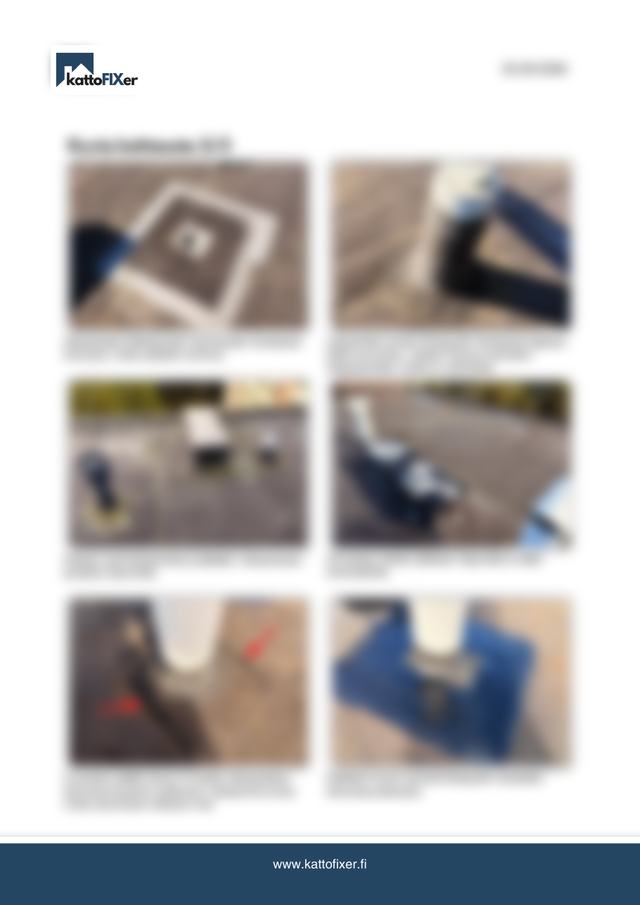 Sample report · content blurred
Inspection, annual maintenance and urgent repairs are done on the same visit. That saves the housing company money.
Calling about every finding separately, waiting for decisions and making another visit always costs money. That is why the scope of urgent repairs is agreed in advance in the lifecycle contract, so the property manager doesn't have to order them separately.
A manufacturer may promise a 50-year warranty on a metal roof, yet the roof is still replaced after just 25 years. Technical service life, warranty and everyday reality rarely meet.
Tip: Regular inspection and maintenance bring them together.
For most roofs we recommend an inspection in spring and autumn. The interval can be adjusted if needed, based on the report.
Leaking water soaks insulation and structures long before it shows indoors. An inspection finds the risk points before they become leaks, and regular maintenance keeps the roofing's service life where the manufacturer promised.
Photos and findings, recommended actions in order of urgency, cost estimates and maintenance instructions. Every visit is archived as a roof history that stays with the property.
Yes. Urgent repairs are carried out during the same visit, so the property manager doesn't need to order them separately. The scope of repairs is agreed when the lifecycle contract is signed.
Yes. The report is designed so that the actions and their urgency can be transferred directly into the maintenance needs assessment.
Yes, when needed. We are a drone operator registered and approved by Traficom.
For an acute leak, call – it is always the fastest way. Otherwise, send an enquiry or quote request and we'll get back to you.
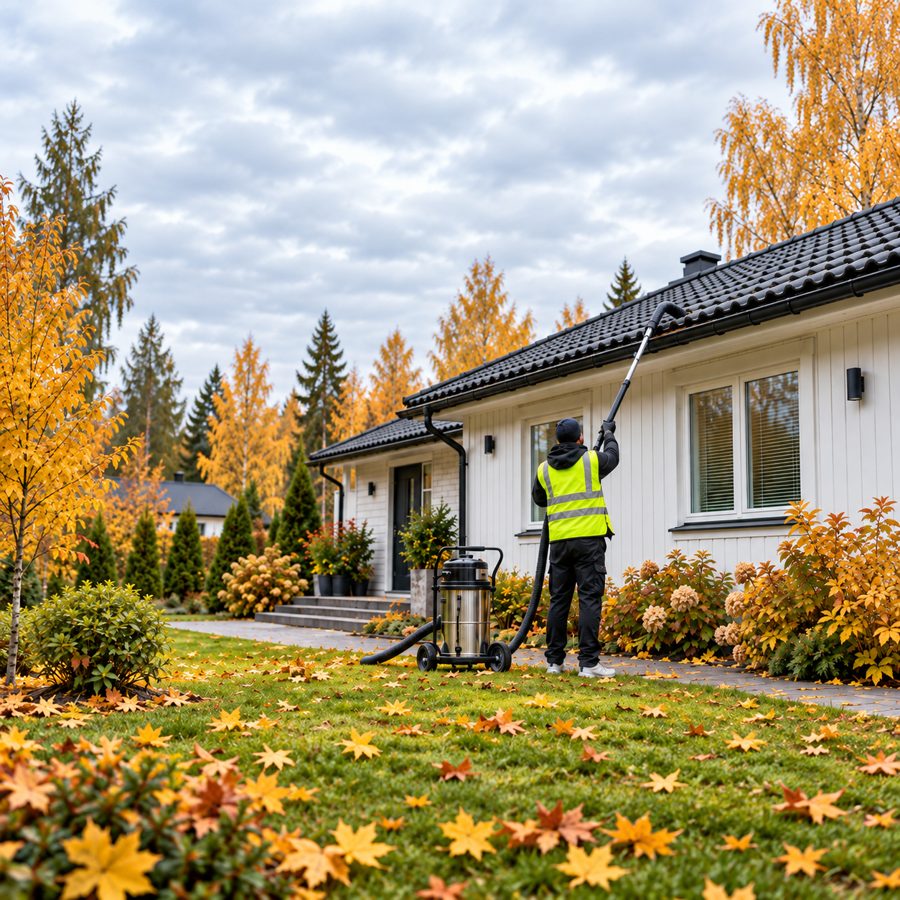 AUTUMN OFFER FOR DETACHED AND TERRACED HOUSES
Full gutters freeze, overflow and rust. We clear them safely and tidily from the ground with high-pressure vacuum equipment up to 12 metres. Tampere, Kangasala, Pirkkala, Ylöjärvi and Nokia.
Updated: 6 November 2026
Gewerk Finland Oy (marketing name for housing company services: KattoFIXer.fi)
Business ID: 3631966-2
Tampere
E-mail: kattofixer@gmail.com / gewerkfinland@gmail.com
Phone: +358 45 2017 305
This privacy policy covers the products and services offered by KattoFIXer and the website kattofixer.fi.
We may collect the following data in connection with an enquiry and/or customer relationship:
Through the website we collect the following data:
We do not, however, collect any data that identifies you, and we do not share even this traffic data. Visitor statistics are produced with the Finnish Metrimato service, which sets no cookies and stores no IP addresses or other visitor identifiers. The statistics are kept on servers in Finland for at most 6 months and are then deleted automatically. Browser Do Not Track and Global Privacy Control settings are respected.
The details you send through the contact form (name, phone number, e-mail address, town, property details and message) are delivered to our e-mail via the Web3Forms service. Web3Forms does not store form contents, and its technical logs are deleted roughly every two months.
We therefore collect identifying data directly from you when you place an order, get in touch or use the service.
Personal data is processed for the following purposes:
Personal data is processed on the basis of:
The website does not use any payment services.
We may disclose personal data to the following parties:
Data is not sold to third parties.
Data may be transferred outside the EU/EEA, for example when international technical services are used. The website host Cloudflare, the form service Web3Forms and the e-mail service Google also operate in the United States. Visitor statistics (Metrimato) are stored in Finland. Transfers are carried out with safeguards under the GDPR, such as the European Commission’s standard contractual clauses.
We keep personal data only for as long as necessary:
Personal data is protected by appropriate technical and organisational measures:
You have the right to:
You can exercise your rights by contacting: kattofixer@gmail.com
You also have the right to lodge a complaint with the supervisory authority. In Finland, this is the Office of the Data Protection Ombudsman (www.tietosuoja.fi).
The KattoFIXer website uses no tracking or advertising cookies and no cookies that identify you. The site stores only what it needs to work in your browser (in a cookie or the browser’s local storage): that you accepted the cookie notice (30 days), that the campaign notice was shown (3 days) and the language you chose. None of this can identify you, and it is not sent to us.
For an acute leak, call 045 2017 305 – it is always the fastest way. Otherwise, leave a message and we'll get back to you.
We collect analytics, but no data that identifies you, and we do not share even that. We only store what the site needs to work in your browser, such as hiding this notice for 30 days. We use a Finnish analytics service and respect your privacy.
Privacy policyIn many cases, yes. Targeted repairs, sealing of risk points, protective treatments and regular monitoring keep a roof working for longer. The key is to identify what needs action now and what can wait.
Yes. Winter sealing can be applied to wet surfaces and in temperatures as low as −25 °C. The leak is stopped straight away, and the permanent repair is done when the weather allows.
Spring and autumn are the key times. In spring you can see any damage from winter and snow clearing; in autumn you make sure the roof and drainage work before winter.
When nobody keeps an eye on the roof, drying out and cracking of the roofing with age go unnoticed, as do dirt, moss, standing water, splitting seams and minor damage. Systematic maintenance and checking that the roof stays watertight and elastic are the most important ways to extend the life of a flat bitumen roof.
In Pirkanmaa, Häme and Satakunta. If needed, we'll go anywhere!
KattoFIXer.fi is the marketing name of Gewerk Finland Oy's (Business ID 3631966-2) services for housing companies. We are an authorised Enke Werk installation team and have been looking after roofs since 2013.
We don't sell complete roof replacements. We only recommend replacement when repairs and maintenance alone are no longer worthwhile.
The product is for professional use only and may be installed only by a trained and certified installation team. KattoFIXer is an authorised Enke Werk installation team.
The sealing is used on metal, standing-seam and bitumen roofs, for example, as well as in gutters and roof windows. We always assess suitability on site.
Yes. The sealing can be painted over. On metal roofs we recommend EMP anti-corrosion paint.
Enkopur® sealing has a technical service life of 25 years.
One high-build coat is enough. EMP (Enke Multi Protect) bonds chemically to the metal and stops corrosion.
EMP is solvent-based, so it dries quickly. The surface is rainproof after about 30 minutes.
The standard colours are anthracite, red-brown, grey, patina, black and white-grey. Custom tinting is also available to order.
Not necessarily. Enkonol treatment soaks into the membrane and restores the bitumen's flexibility. We maintain bitumen roofs dating from 1992 that have still not been replaced.
No. Enkonol does not seal on its own. Sealing is done with Enkopur® before the bitumen treatment.
All bitumen roofing: flat and pitched roofs, plus granule-surfaced and smooth Derbigum bitumen roofing.
Arctic Seal is suitable for metal, bitumen, tile and other roofing materials.
Arctic Seal stops the leak immediately, whatever the weather. When conditions allow, the leak point is sealed with long-life sealing.
Detached houses, terraced houses and small blocks of flats are cleared safely from the ground with high-pressure vacuum equipment up to a height of 12 metres. Larger buildings are cleared from the roof using a vacuum truck.
Autumn offer from 99 € (incl. VAT 25.5%) in Tampere and the surrounding area. The final price depends on the size and complexity of the property. Order together with your neighbours and we'll take it into account in the price.
The labour cost is eligible for the household tax credit for private customers.
When water can't reach the downpipe, it overflows and can get into the structures. Decaying debris corrodes the gutters and adds weight, and in winter the blockage freezes.
For most roofs we recommend an inspection in spring and autumn. The interval can be adjusted if needed, based on the report.
Leaking water soaks insulation and structures long before it shows indoors. An inspection finds the risk points before they become leaks, and regular maintenance keeps the roofing's service life where the manufacturer promised.
Photos and findings, recommended actions in order of urgency, cost estimates and maintenance instructions. Every visit is archived as a roof history that stays with the property.
Yes. Urgent repairs are carried out during the same visit, so the property manager doesn't need to order them separately. The scope of repairs is agreed when the lifecycle contract is signed.
Yes. The report is designed so that the actions and their urgency can be transferred directly into the maintenance needs assessment.
Yes, when needed. We are a drone operator registered and approved by Traficom.
You choose the recipients yourselves – for example the property manager, the maintenance company and the chair of the board. Alerts arrive by text message and/or e-mail.
In existing buildings, structures do need to be opened up. The sensors are wireless, however, and can easily be installed in new builds during construction.
The sensors' built-in battery lasts more than 20 years.
Yes. System installation and equipment are charged separately. Monitoring complements the spring and autumn inspections, and alerts are logged in the same maintenance history. Monitoring is also charged at a monthly fee based on the number of sensors.
An initial inspection goes over the roof and photographs it. A lifecycle plan is then drawn up, scheduling and pricing the actions for the budget. Spring and autumn visits cover inspections, minor repairs and the gutters, and the board receives a report after every visit.
Yes. The actions are scheduled, so they can be transferred directly to the PTS and the budget.
No results. Give us a call – we're happy to help.